


Imagine this.
You are standing in the middle of a supermarket with a trolley full of groceries when your three-year-old spots something they desperately want.
You say no.
Within seconds, your child is on the floor.
Crying. Screaming. Perhaps kicking their legs while you stand there wondering how such an enormous emotional event emerged from one very small packet of biscuits.
People are looking.
You can feel yourself getting warmer.
And somewhere between “Please get up” and “We are absolutely not buying that now,” you find yourself wondering:
What is happening to my child? Is my child okay? Are they testing me? And what am I actually supposed to do right now?
Now imagine another child.
They are at a birthday party. The music is loud. Children are running everywhere. Balloons keep popping. People talk to them, touch them, ask questions, and encourage them to join activities.
They were managing.
Until suddenly, they weren’t.
The child covers their ears. They begin screaming. Someone tries to comfort them, and they push the person away. They cannot seem to answer questions. They just need everything to stop.
From the outside, these two children may look remarkably similar.
But what is happening underneath the behaviour may be quite different.
Understanding that difference can completely change how we respond.
Before We Talk About Behaviour, Let's Talk About Development
There is something we need to establish first.
Children are not miniature adults.
They are developing humans with brains, nervous systems, language, executive functions, social understanding and emotional regulation capacities that are still developing.
This becomes particularly important during the toddler and preschool years.
Think about what we ask a young child to learn in just a few years.
- Wait.
- Share.
- Stop something enjoyable.
- Accept “no.”
- Move from one activity to another.
- Communicate frustration instead of acting it out.
- Control an impulse.
- Tolerate disappointment.
- Understand another person’s perspective.
- Calm themselves when something feels overwhelmingly important.
These are sophisticated developmental achievements.
And they do not arrive all at once.
A two-year-old can have a very clear idea about which cup they want while having very little capacity to manage what happens inside them when that cup is unavailable.
A four-year-old may understand that it is time to leave the playground and still find the transition enormously difficult.
This is one reason tantrums are especially common in early childhood. The child’s desire for independence, agency and exploration is expanding rapidly, while language, inhibitory control, cognitive flexibility and emotion-regulation capacities are still developing.
In simple terms:
Big feelings can arrive before the child has developed equally big skills for managing them.
And this is where adults become enormously important.
Children gradually develop self-regulation through maturation, experience and repeated opportunities to practise regulation, including within relationships where adults provide co-regulation.
So when a child falls apart, the first question does not always need to be:
How do I stop this behaviour?
Sometimes a more useful question is:
What is happening developmentally for this child right now?
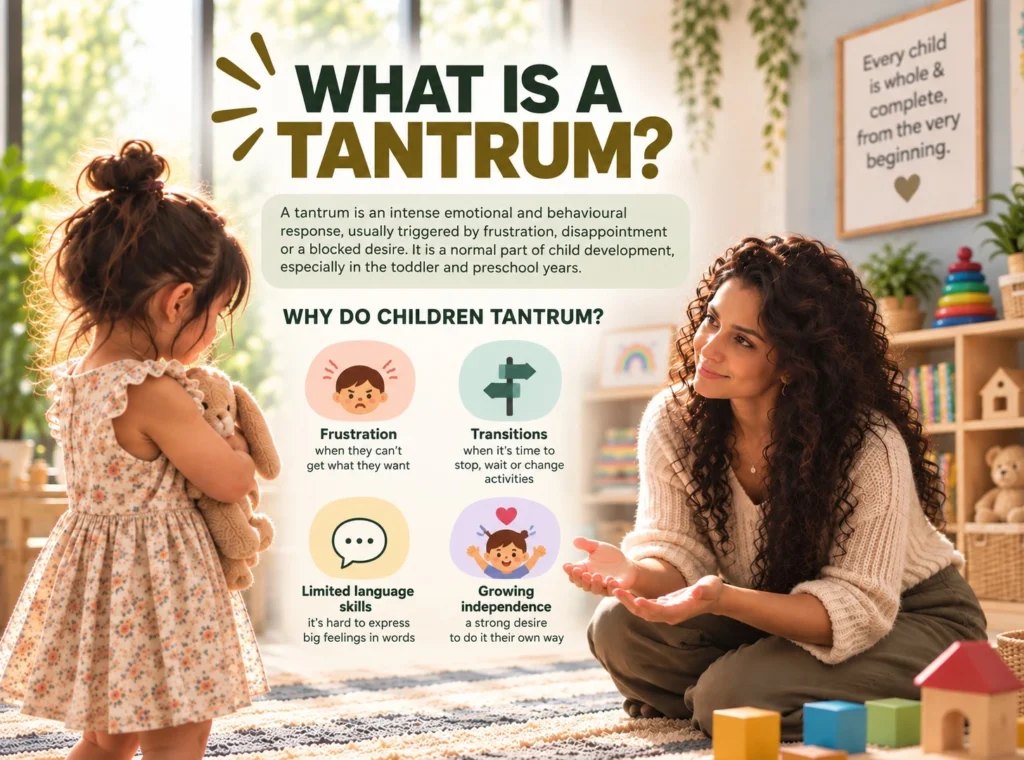
So, What Exactly Is a Tantrum?
Let’s return to our supermarket.
Your child wants the biscuits.
You say no.
They cry, protest, perhaps throw themselves onto the floor and repeatedly tell you:
“But I WANT it!”
A tantrum usually has something identifiable at its centre.
- I want that.
- I don’t want to leave.
- I wanted to do it myself.
- I don’t want my brother to have it.
- I wanted the blue cup.
To an adult, some of these reasons can seem almost comically small.
But imagine being three.
You have only recently discovered that you are an individual with preferences, desires and increasing autonomy.
You know what you want.
Unfortunately, you have not yet mastered what to do with yourself when the world says no.
That developmental gap is fertile ground for tantrums.
A tantrum is generally an intense emotional and behavioural response associated with frustration, anger, disappointment, blocked goals, transitions, demands or difficulty communicating what the child wants or needs.
A child may cry, yell, stamp their feet, throw themselves down, kick, hit, throw objects, cling, protest or repeatedly demand something.
And here we need to correct a common misconception.
“They’re Just Doing It to Get What They Want.”
Sometimes there is a goal involved.
- The child wants the toy.
- The child does not want to leave the park.
- The child wants you to pick them up.
But that does not automatically mean the emotional experience is fake, calculated or manipulative.
A young child can genuinely be dysregulated and desperately want something at the same time.
Those realities can coexist.
We need to be careful about imposing sophisticated adult motives onto behaviour emerging from an immature regulatory system.
The more useful question is not:
“Are they manipulating me?”
but:
“What are they trying to accomplish or communicate, and what developmental skills are they struggling to use?”
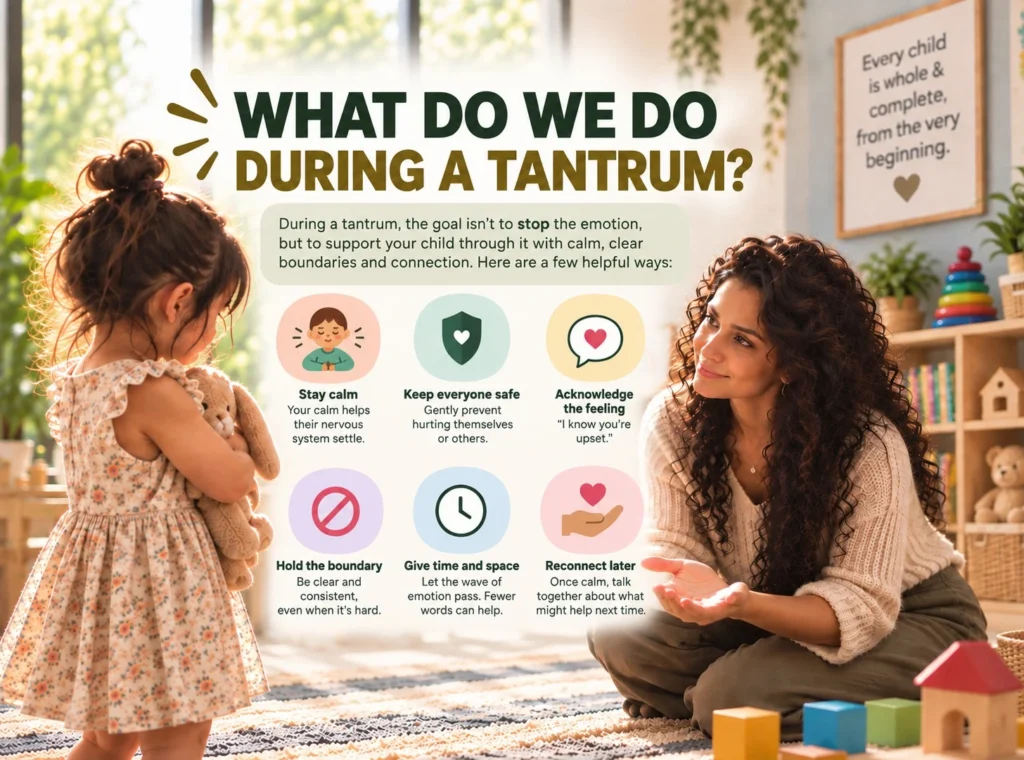
Why Do Children Tantrum?
Sometimes the answer really is quite straightforward.
You said no.
They wanted yes.
But children also tantrum because waiting is hard. Transitioning is hard. Losing is hard. Sharing is hard. Being interrupted is hard. Communicating complicated internal experiences with a limited vocabulary is hard.
And then there is something parents often know intuitively:
The same child does not have the same capacity every day.
Think about your own experience.
You can probably tolerate an inconvenient email reasonably well after a good night’s sleep and a peaceful morning.
Receive the same email after five hours of sleep, three stressful meetings, no lunch and an argument with someone you love?
It may land very differently.
Children are no different in that respect, except their regulatory capacities are considerably less mature.
- Hunger matters.
- Fatigue matters.
- Illness matters.
- Overstimulation matters.
- Changes in routine matter.
- Family stress can matter.
- And accumulated demands across the day matter.
This is also where an attachment-informed and trauma-informed perspective invites us to become curious without over-pathologising.
Sometimes a tantrum is simply a developmentally ordinary response to frustration.
Not every tantrum is trauma.
Not every difficult behaviour indicates insecure attachment.
But sometimes the child who appears to be fighting over something very small is already carrying something much larger.
- Perhaps there has been a new sibling.
- Perhaps mornings have become rushed and disconnected.
- Perhaps separations have been difficult recently.
- Perhaps school has been demanding.
- Perhaps the child simply needs more connection than they have been able to communicate.
The biscuit may be the trigger. It is not necessarily the whole story.
Why Do Children Tantrum?
Here is where parenting can become uncomfortable.
Because being developmentally responsive does not mean giving the child whatever they want.
Imagine the supermarket again.
You have said no to the biscuits.
Your child begins screaming.
You become embarrassed and hand them the packet just to make the screaming stop.
Understandable?
Absolutely.
But if this becomes a repeated pattern, the child can learn something very practical:
Sometimes escalating my protest changes the boundary.
Now consider the opposite response.
“Stop behaving like a baby.”
“Everyone is looking at you.”
“This is embarrassing.”
“You’re being ridiculous.”
The boundary may remain intact, but now the child faces the original disappointment and shame.
There is another possibility.
You crouch down.
You keep your voice relatively calm.
“I know. You really wanted those biscuits. You’re disappointed.”
And then:
“We’re not buying them today.”
That’s it.
Connection and boundary.
The feeling is allowed.
The limit remains.
You do not need to give a TED Talk about emotional regulation while your three-year-old is screaming beside the cereal aisle.
In fact, fewer words are often better when arousal is high.
Keep everyone safe. Stay as regulated as you reasonably can. Avoid unnecessary negotiation. Allow the emotional wave to pass.
Teaching can happen later.
When your child is calm, then there may be room for:
“That was really hard when I said no. What can we do next time when you’re disappointed?”
We regulate first.
We teach when the brain is available for learning.
And Then There Is the Meltdown
Now let’s return to the birthday party.
The child who eventually screamed and covered their ears may not have been trying to obtain anything at all.
Perhaps they had been coping for an hour.
The music was loud.
The room was crowded.
Someone popped a balloon.
Three adults asked them questions.
Another child kept touching them.
The plan changed unexpectedly.
They were hungry.
They were tired.
And then someone accidentally bumped into them.
Suddenly, everything fell apart.
An adult watching from across the room might conclude:
“They had a meltdown because another child bumped into them.”
But perhaps they didn’t.
Perhaps the bump was simply the final demand placed upon a system that had already reached its limits.
That distinction matters.
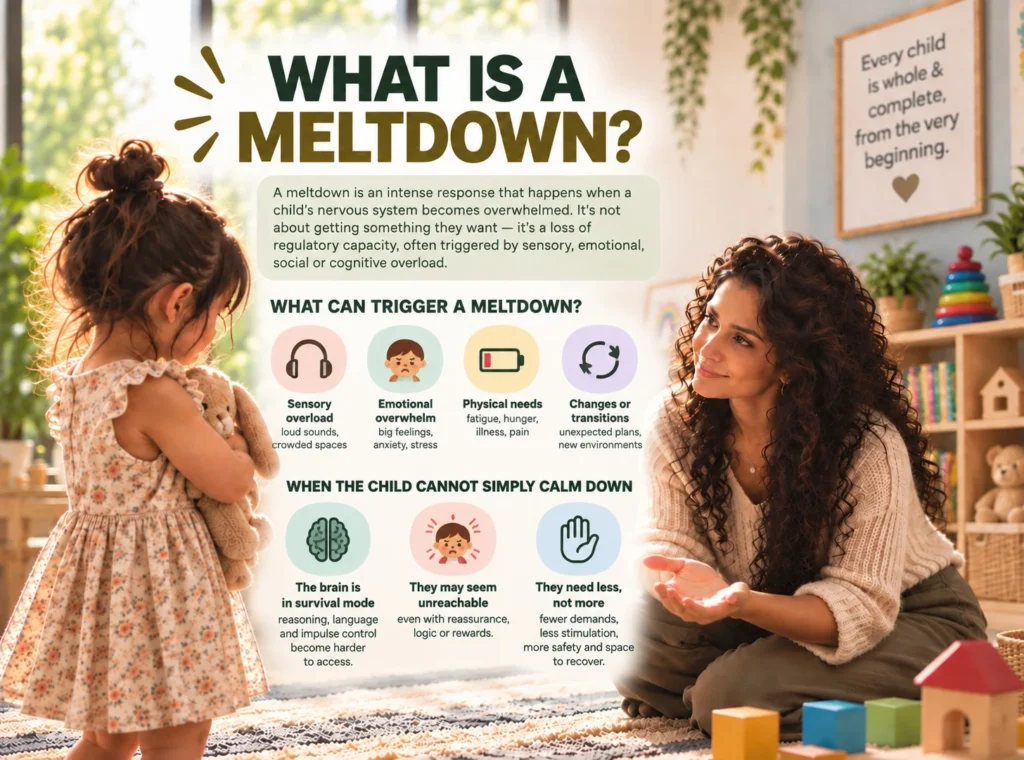
What Is a Meltdown?
The term meltdown is commonly used to describe an intense response that occurs when a person’s regulatory capacity becomes overwhelmed. It is important to note that a meltdown is a descriptive term, not a standalone psychiatric diagnosis.
Meltdowns are frequently discussed in relation to autistic children and other neurodivergent children, particularly when sensory processing and regulatory differences are involved. But overwhelming dysregulation is not exclusive to autism, and a meltdown by itself should never be used to diagnose a child.
A meltdown may emerge when the demands placed upon the child’s nervous system exceed the resources currently available to manage them.
Those demands might be;
- Sensory.
- Emotional.
- Cognitive.
- Social.
- Physiological.
Or, very often, several of these at once.
A child may scream, cry, cover their ears, run away, hide, push people away, lash out, collapse or become temporarily unable to communicate effectively.
But here is something equally important:
Not every overwhelmed child becomes loud.
Some become quiet.
They may freeze.
Withdraw.
Stop speaking.
Hide.
Become unusually still.
Or appear disconnected from everything happening around them.
Overwhelm does not always announce itself dramatically.
When the Child Cannot Simply “Calm Down”
This is perhaps one of the most important distinctions for adults to understand.
During significant overwhelm, the child’s access to flexible thinking, language processing, attention, inhibition and problem-solving may become temporarily reduced.
Which means that the adult may say:
“Use your words.”
“Tell me what’s wrong.”
“Stop screaming.”
“Look at me when I’m speaking to you.”
“Why are you doing this?”
And the child may genuinely have limited capacity to comply with those demands at that moment.
It is a little like asking someone to solve a complicated mathematics problem while a fire alarm is sounding beside their head.
The ability may exist.
Access to the ability is the problem.
That’s why our response to a meltdown needs to be different.
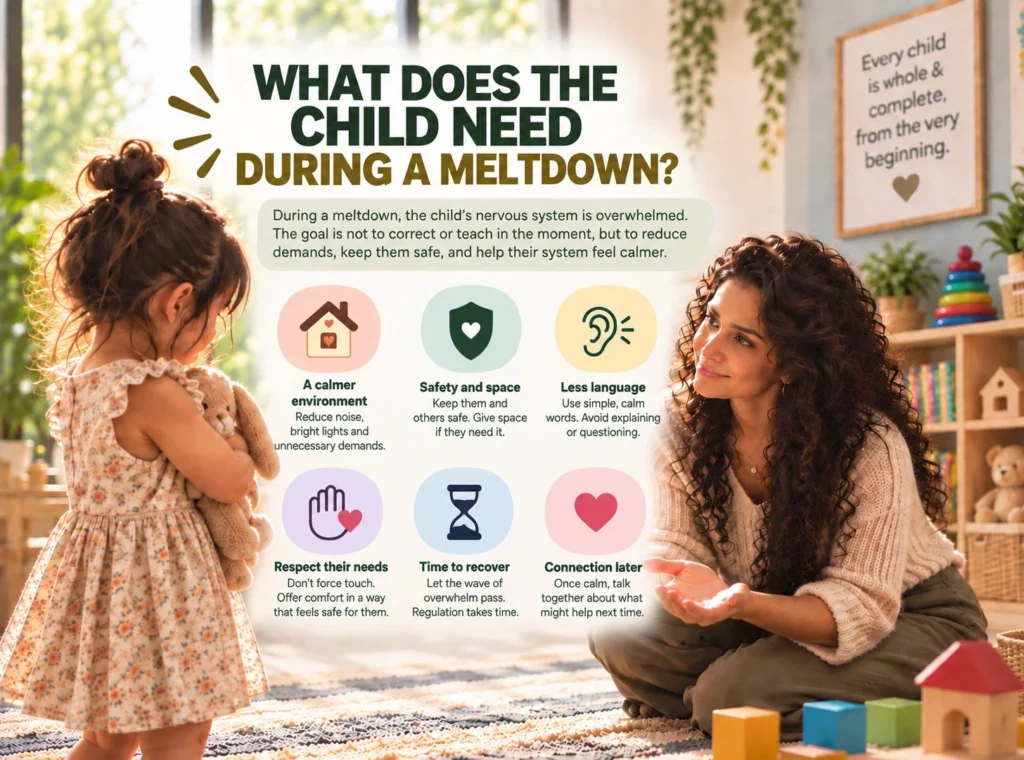
What Does a Child Need During a Meltdown?
Usually, less.
Less language.
Less stimulation.
Fewer demands.
Less questioning.
Less social pressure.
- If possible, move toward a quieter and more predictable environment.
- If the child is sensitive to sound, reduce noise.
- If they do not want to be touched, do not assume that physical affection will automatically regulate them.
- If they need space, give appropriate space while maintaining safety.
- If there is a risk of injury, the immediate priority becomes keeping the child and others safe using the least intrusive response appropriate to the situation.
This is not the moment to demand an apology.
It is not the moment to teach a lesson.
And it is certainly not the moment to insist:
“You need to tell me why you did that.”
The child may not yet know.
Later, once the child has recovered, we can become curious together.
“I noticed the room was getting really loud before things became difficult.”
“You were covering your ears for a while.”
“I wonder if everything became too much.”
“What could we do next time when you notice that feeling beginning?”
Now we are not simply responding to the meltdown.
We are helping the child gradually develop awareness of their internal signals and strategies to respond earlier.
Tantrum or Meltdown: How Do I Actually Know?
This is where I want to resist giving parents a neat little checklist.
Human behaviour is rarely that tidy.
There is no single behaviour that tells us:
This is definitely a tantrum.
or:
This is definitely a meltdown.
A child can scream during both.
Cry during both.
Kick during both.
Fall onto the floor during both.
And sometimes an episode that begins with ordinary frustration can escalate until the child becomes genuinely overwhelmed.
So instead of looking only at the behaviour, look at the context, function and capacity underneath it.
A tantrum often occurs around a blocked goal, limit, frustration, autonomy struggle or desired outcome:
“I want something to be different.”
A meltdown is more centrally characterised by overload:
“This has become more than I can manage.”
During a tantrum, the child may retain some capacity to engage with what is happening around them, negotiate, monitor the adult’s response or change course when circumstances change.
During a significant meltdown, those capacities may become substantially reduced because the child is overwhelmed.
But there will be grey areas.
And that is okay.
The goal is not to become extraordinarily good at labelling children.
The goal is to become better at understanding them.
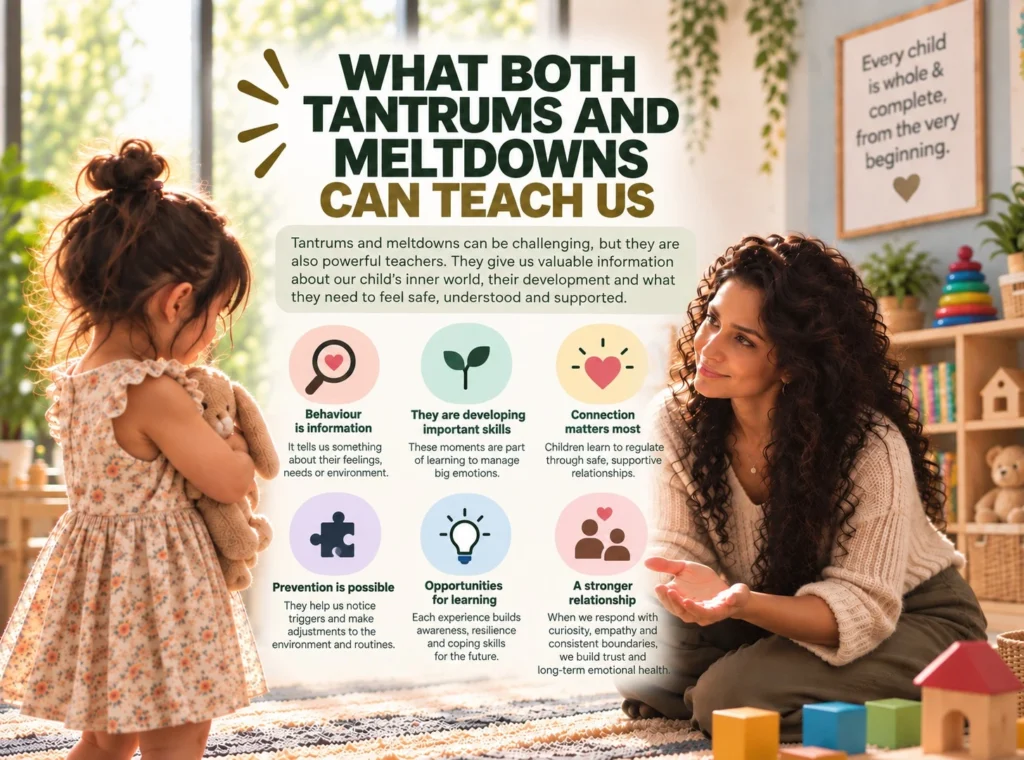
What Both Tantrums and Meltdowns Can Teach Us
There is one principle I return to again and again when thinking about children’s behaviour:
Behaviour is information.
That does not mean behaviour has no boundaries.
It does not mean hitting becomes acceptable because a child is dysregulated.
It does not mean parents should remove every frustration from a child’s life.
And being trauma-informed does not mean interpreting every tantrum as evidence of trauma.
A child can be furious that you said no while the answer remains no.
A child can be overwhelmed while adults maintain the boundaries necessary for safety.
A child can dislike a limit and still experience the adult setting that limit as emotionally safe.
This is where developmental, attachment-informed and trauma-informed practice meet.
We are not choosing between connection and boundaries.
Children need both.
Secure relationships are not relationships in which children are never disappointed, frustrated or distressed.
They are relationships in which difficult experiences can happen within an environment of sufficient safety, responsiveness, predictability, appropriate limits, connection and repair.
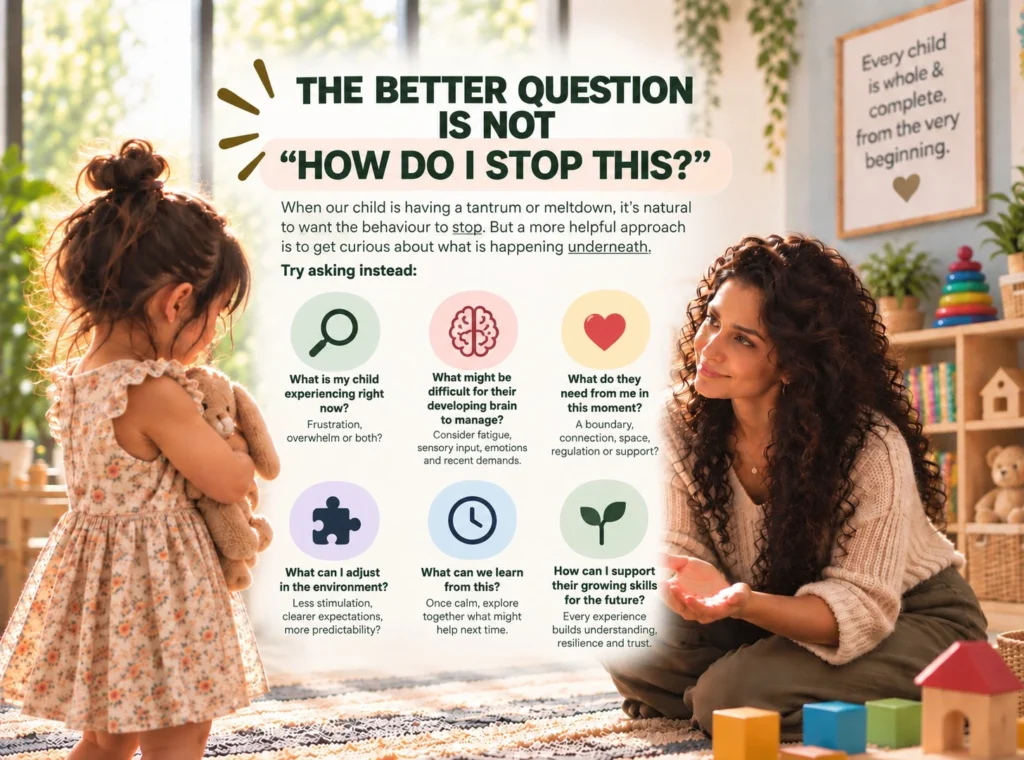
Perhaps the Better Question Is Not “How Do I Stop This?”
The next time your child is screaming in the supermarket, refusing to leave the playground, falling apart after school or becoming overwhelmed at a birthday party, notice what happens inside you too.
You may feel embarrassed.
Frustrated.
Helpless.
Angry.
Exhausted.
You may notice other adults looking at you.
And suddenly you are not only managing your child’s nervous system.
You are managing your own.
In those moments, it can be tempting to make the behaviour stop as quickly as possible.
But perhaps we can become curious before we become corrective.
Instead of only asking:
“How do I stop this behaviour?”
we might ask:
“What is happening for my child right now?”
“What capacity is difficult for them to access?”
“Is this frustration, overwhelm, r perhaps some of both?”
And finally:
“What does my child need from me in this particular moment?”
Sometimes the answer will be a firm boundary.
Sometimes it will be fewer words.
Sometimes it will be sensory relief.
Sometimes it will be food, sleep, predictability or preparation for a transition.
Sometimes it will be connection.
Sometimes it will be space.
And sometimes what the child needs most is simply an adult who can remain steady enough to communicate:
“This is difficult. The boundary is still here. And so am I.”
Children do not learn emotional regulation because the adults around them successfully prevent every episode of dysregulation.
They learn gradually, through development, relationships and experience.
They experience frustration.
They become overwhelmed.
They recover.
They receive co-regulation.
They practise new skills.
They discover their own signals.
And over thousands of ordinary interactions, capacities that once depended heavily on another person gradually become more available from within.
So perhaps a tantrum or a meltdown is not simply an interruption to get through.
It is also information.
Information about development.
Information about capacity.
Information about the environment.
And sometimes, information about what this particular child needs from the adults around them.
When we learn to look underneath behaviour, we do not become permissive.
We become more precise in how we respond.
Continue the Impact Beyond This Article
If this topic resonated with you, and you feel a strong calling to make a meaningful difference in the lives and development of children, adolescents and families, you may wish to take this work beyond awareness and into professional practice.
Explore the world’s first ICF-accredited Whole-Child & Family Coaching Education Specialization, an evidence-informed professional pathway integrating developmental science, attachment, trauma-informed practice, family systems and professional coaching.
Turn your calling into an informed, ethical and developmentally responsive practice.
Read More: Tantrums That Seem to Come Out of Nowhere: What’s Really Happening in Your Child’s Brain. Click here.
Share the Love: If this article touched you, share it with someone who may need these words today. Sometimes, the smallest act of passing on knowledge creates the biggest ripple in someone’s healing journey.
References
Bowlby, J. (1969) Attachment and Loss: Volume I – Attachment. London: Hogarth Press.
Bowlby, J. (1988) A Secure Base: Parent-Child Attachment and Healthy Human Development. London: Routledge.
van der Kolk, B. (2014) The Body Keeps the Score: Brain, Mind, and Body in the Healing of Trauma. New York: Viking.
Porges, S.W. (2011) The Polyvagal Theory: Neurophysiological Foundations of Emotions, Attachment, Communication, and Self-Regulation. New York: W.W. Norton & Company.
Porges, S.W. (2022) Polyvagal Safety: Attachment, Communication, Self-Regulation. New York: W.W. Norton & Company.
Ainsworth, M.D.S., Blehar, M.C., Waters, E. and Wall, S. (1978) Patterns of Attachment: A Psychological Study of the Strange Situation. Hillsdale, NJ: Lawrence Erlbaum Associates.
Siegel, D.J. (2012) The Developing Mind: How Relationships and the Brain Interact to Shape Who We Are. 2nd edn. New York: Guilford Press.
Siegel, D.J. and Bryson, T.P. (2012) The Whole-Brain Child: 12 Revolutionary Strategies to Nurture Your Child’s Developing Mind. New York: Delacorte Press.
Shonkoff, J.P. et al. (2012) ‘The lifelong effects of early childhood adversity and toxic stress’, Pediatrics, 129(1), pp. e232–e246. https://doi.org/10.1542/peds.2011-2663
Felitti, V.J. et al. (1998) ‘Relationship of childhood abuse and household dysfunction to many of the leading causes of death in adults’, American Journal of Preventive Medicine, 14(4), pp. 245–258.
The Royal Foundation of The Prince and Princess of Wales (2023) Shaping Us: Early Childhood Campaign. Available at: https://www.royalfoundation.com/shaping-us/
(Accessed: [insert date]).
Shaping Us (2023) Public attitudes to early childhood development and mental health. London: The Royal Foundation.